
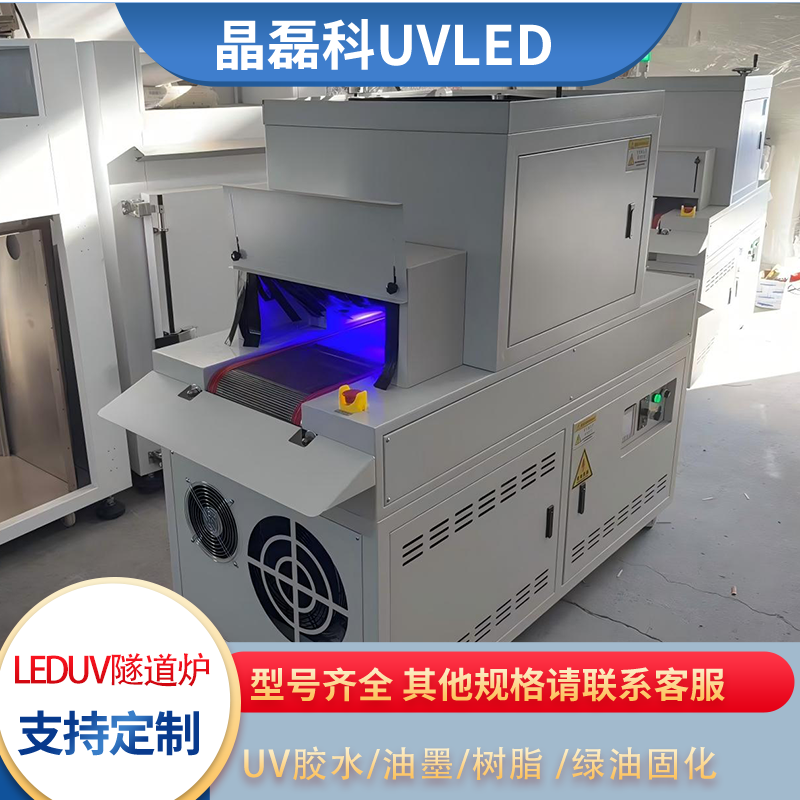

Energy-saving and efficient
1.Compared with traditional curing equipment such as mercury lamps, LED curing lamps have significant energy-saving advantages.
LED curing lamps generate light of specific wavelengths through light-emitting diodes, and their efficiency in converting electrical
energy to light energy is relatively high. For instance, the photoelectric conversion efficiency of LED curing lamps can reach around
60% - 80%, while that of traditional mercury lamps is usually below 30%. This means that under the same curing effect, LED curing
lamps consume less electricity, effectively reducing energy costs.
2.Moreover, LED curing lamps do not require preheating like mercury lamps and can be turned on and off instantly. In scenarios of
intermittent curing operations, this immediate response characteristic can further save energy, reduce equipment waiting time,
and improve production efficiency.
Fast curing speed
1.LED curing lamps emit light within a specific wavelength range, and their spectra can be precisely customized according to different
photocurable materials. Generally, the wavelengths of LED curing lamps are mainly concentrated between 365 - 405nm, and light within
this wavelength range can efficiently activate the photoinitiators in photocurable materials. Once the photoinitiators are activated, they
quickly trigger polymerization reactions, causing the materials to cure rapidly.
2.For example, in the curing application of UV adhesives, LED curing lamps can complete the curing process within a few seconds to tens of
seconds, significantly shortening the curing time compared to traditional natural drying or thermal curing methods, and improving production
efficiency.
Long service life
The light-emitting diodes in LED curing lamps have a long lifespan. Generally, the service life of LED curing lamps can reach 20,000 - 50,000 hours.
This is because LEDs are solid-state semiconductor devices and do not have the filament burnout or tube aging problems found in traditional bulbs.
For instance, in a production workshop that operates 8 hours a day, an LED curing lamp can last for 6 - 14 years (assuming 300 working days a year),
greatly reducing the frequency of equipment replacement, lowering maintenance costs, and minimizing waste generation.
Environmental friendliness
LED curing lamps do not contain harmful elements such as mercury. When traditional mercury lamps are discarded, if not handled properly, mercury
can cause severe environmental pollution. However, LED curing lamps do not pose this risk and are a more environmentally friendly curing device.
Furthermore, due to the precise spectral output of LED curing lamps, they can reduce unnecessary light radiation during the curing process, lowering
potential harm to the surrounding environment and operators. Additionally, LED curing lamps generate relatively less heat during operation, which
also helps reduce the energy consumption of cooling equipment such as air conditioners in the workshop, indirectly reducing carbon emissions.
High safety
LED curing lamps produce much less heat than traditional mercury lamps. This is because the light-emitting principle of LED curing lamps is based
on electroluminescence of semiconductors, rather than the high-temperature arc of mercury lamps. The lower heat output reduces the risk of fire
caused by high temperatures and makes the operation process safer for operators, preventing burns.
Moreover, the operating voltage of LED curing lamps is relatively low, typically ranging from a few volts to tens of volts. Compared to some traditional
curing equipment driven by high voltages, this significantly reduces the risk of electric shock.
Good curing quality
LED curing lamps can provide stable wavelength and light intensity output. This ensures that photocurable materials receive uniform light during the
curing process, guaranteeing the stability of curing quality. For example, in the application of photocurable coatings, LED curing lamps can ensure that
both the surface and interior of the coating receive appropriate light, ensuring good performance in terms of hardness, gloss, and adhesion after curing.
Moreover, because LED curing lamps can precisely control the wavelength of light, they can select the most suitable wavelength according to different
light-curing materials, making the curing reaction of the materials more complete and efficient, and reducing the occurrence of curing defects such as
bubbles and cracks.