
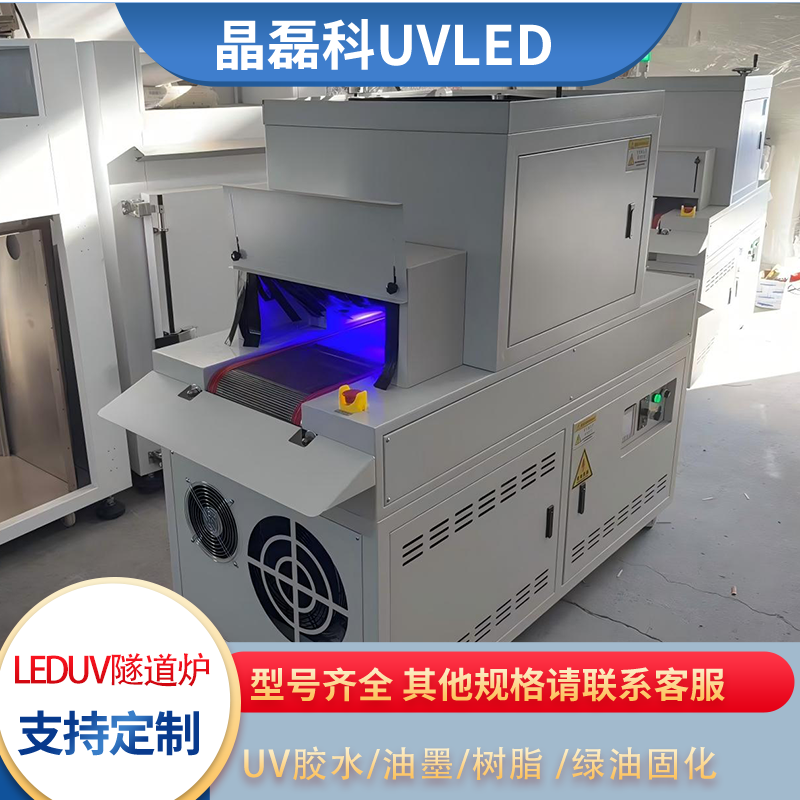

LED UV curing lamps and traditional mercury lamps each have their characteristics in UV curing technology, with the main differences being as follows:
1. Light Emitting Principle
LED UV lamps:
Emit ultraviolet light (such as 365nm, 385nm, 395nm, etc.) of specific wavelengths through semiconductor light-emitting diodes (LEDs),
with a narrow and concentrated spectrum that does not require filters.
Mercury lamps:
Depend on the ionization of mercury vapor to produce ultraviolet light, with a wide spectral range (including UV-A, UV-B, UV-C, as well as
visible light/infrared), requiring filters to remove the ineffective spectrum.
2. Energy Consumption and Efficiency
LED UV lamps:
Low energy consumption (only 10%-30% of that of mercury lamps), high electro-optical conversion efficiency (about 30%-40%).
Instant on, no preheating/cooling time required.
Mercury lamps:
High energy consumption, with a large amount of energy converted into heat (efficiency about 15%-25%).
Require preheating (1-5 minutes), and need to cool down after being turned off.
3. Lifespan and Maintenance
LED UV Lamp:
Long lifespan (about 20,000-50,000 hours), slow degradation, virtually maintenance-free.
Mercury Lamp:
Short lifespan (about 1,000-2,000 hours), frequent start-up and shutdown accelerate aging, requires regular replacement.
4. Environmental Protection and Safety
LED UV Lamp:
No mercury pollution, complies with RoHS standards; no ozone generation; operates at low temperatures, reducing thermal damage to substrates.
Mercury Lamp:
Contains mercury, requires special disposal upon waste; shortwave UV generates ozone; high temperatures may cause material burns.
5. Application Flexibility
LED UV Lamp:
Available in various wavelengths to accommodate different photoinitiators; small size suitable for portable devices or precision curing (such as 3D printing, electronic coatings).
Mercury Lamp:
Wide spectrum suitable for a variety of curing needs, but less flexible; commonly used in traditional printing, wood finishing.
6. Cost
LED UV lamps:
Initial investment is high, but they save electricity in the long run and require no maintenance, resulting in a lower overall cost.
Mercury lamps:
Equipment is cheap, but energy consumption and replacement costs are high.
Summary of Selection Recommendations
Choose LED UV lamps: For applications that prioritize energy-saving, environmental protection, long lifespan, precise curing, or
frequent start-stop operations (such as electronics, healthcare, packaging).
Choose mercury lamps: For applications with limited budgets, requiring wide-spectrum curing (such as thick coatings, certain inks),
and not sensitive to heat.
As LED technology develops, its range of applications is gradually replacing mercury lamps, but in some special fields, mercury lamps
still have irreplaceable roles.