
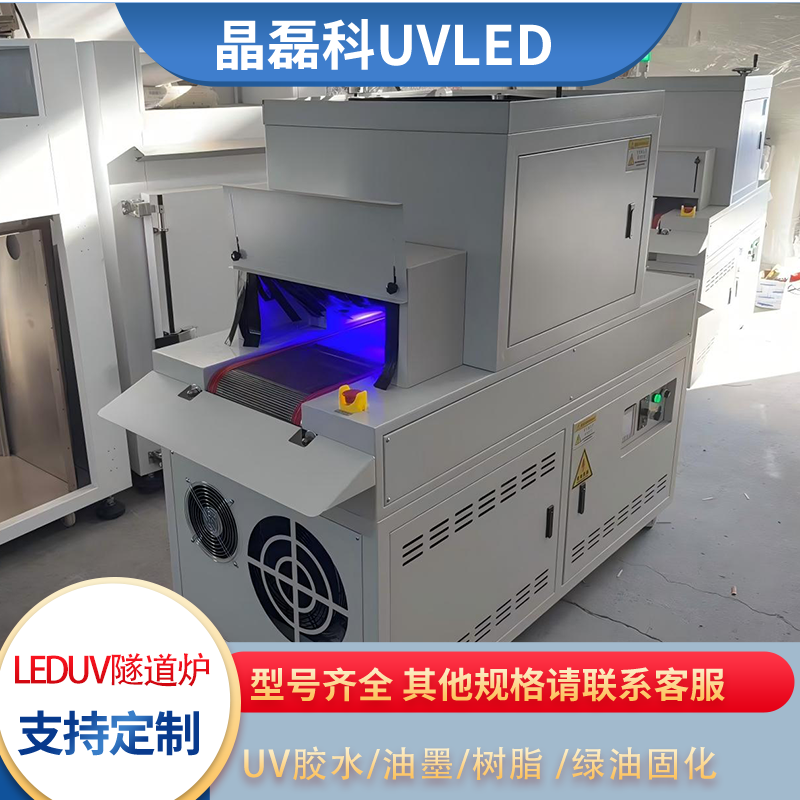

and equipment design. The following are common classifications and selection references:
1. Power Range Classification
Low Power (1W-50W)
Applications: Small 3D printing, dental curing, jewelry coating, electronic component dispensing and curing for precision operations.
Features: Compact size, portable, suitable for localized or small area curing.
Medium Power (50W-500W)
Applications: Printing (labels, packaging), furniture painting, cell phone screen lamination, industrial adhesive curing, etc.
Features: Balances efficiency with cost, commonly used in production line supporting equipment.
High Power (500W-5000W+)
Applications: Automotive coatings, large panel curing, high-speed printing (such as UV flexography), composite material molding, etc.
Features: Multiple LED arrays or high power modules, requiring forced cooling design.
2. Key Selection Factors
Curing Material:
Energy required for ink/coating (for example, UV glue may require 50-200mW/cm², thicker coatings require higher energy).
Irradiation Area:
For large area curing, a higher total wattage is needed (for example, a 30cm wide conveyor may require over 1000W).
Wavelength Matching:
The power efficiency of LEDs with different wavelengths such as 365nm/395nm varies significantly.
3. Practical Case Reference
Small UV Curing Machines: 50W-100W (such as nail polish lamps or PCB localized curing).
Industrial Printers: Single lamp head 300W-1000W, the entire machine may be a combination of multiple lamp heads (for example, label printers with
4×500W lamp heads).
Large Coating Lines: Modular design, total power can reach several thousand watts.
4. Precautions
Power ≠ curing effect: It needs to be comprehensively evaluated in conjunction with irradiance (mW/cm²) and energy density (J/cm²).
Heat Dissipation Requirements: High-power LEDs require air cooling/water cooling systems to avoid light decay.
Power Matching: Constant current drive power is crucial for LED lifespan.
Suggestion: Clarify the material curing requirements (such as required energy, wavelength) first, then consult suppliers to match the power, and if necessary,
perform sample testing.